Showing posts with label The Blessed Eucharist. Show all posts

9/16/2008

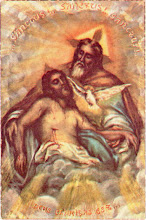
The Feast of the Holy Trinity


The Feast of the Holy Trinity
Trinity Sunday/First Sunday after Pentecost
Taken from, “Divine Intimacy,” by Fr. Gabriel of St. Mary Magdalen, O.C.D., pp. 585-587.

PRESENCE OF GOD – “I return thanks to You, O God, one and true Trinity, one sovereign divinity, holy and indivisible unity. (RB)”.

MEDITATION

1. From Advent until today, the Church has had us consider the magnificent manifestations of God’s mercy toward men: the Incarnation, the Redemption, Pentecost. Now she directs our attention to the source of these gifts, the most Holy Trinity, from whom everything proceeds. Spontaneously, there rises to our lips the hymn of gratitude expressed in the Introit of the Mass: “Blessed be the Holy Trinity and undivided Unity; we will give glory to Him, because He has shown His mercy to us”: the mercy of God the Father, “who so loved the world that He gave it His only-begotten Son” (cf. Fn 3, 16); the mercy of God the Son, who to redeem us became incarnate and died on the Cross; the mercy of the Holy Spirit, who deigned to come down into our hearts to communicate to us the charity of God and to make us participate in the divine life. The Church has very fittingly included in the Office for today the beautiful antiphon inspired by St. Paul: “Caritas Pater est, gratia Filius, communicatio Spiritus Sanctus, O beta Trinitas!”; the Father is charity, the Son is grace and the Holy Spirit is communication: applying this, the charity of the Father and the grace of the Son are communicated to us by the Holy Spirit, who diffuses them in our heart. The marvelous work of the Trinity in our souls could not be better synthesized. Today’s Office and Mass form a veritable paean of praise and gratitude to the Blessed Trinity; they are a prolonged Gloria Patri and Te Deum. These two hymns-one a succinct epitome, and the other a majestic alternation of praises-are truly the hymns for today, intended to awaken in our hearts a deep echo of praise, thanksgiving, and adoration.

2. Today’s feast draws us to praise and glorify the three Persons of the Blessed Trinity, not only because of the great mercy They have shown to men, but also and especially in Themselves and for Themselves: first, by reason of Their supreme essence which had no beginning and will never have an end; next, because of Their infinite perfections, Their majesty, essential beauty and goodness. Equally worthy of our adoration is the sublime fruitfulness of life by which the Father continually generates the Word, while from the Father and the Word proceeds from the Holy Spirit. The Father is not prior to, or greater to the Word; nor are the Father and the Word prior to or greater than the Holy Spirit. The three divine Persons are all co-eternal and equal among Themselves: the divinity and all the divine perfections and attributes are one and the same in the Father, in the Son, and in the Holy Spirit. What can man say in the presence of such a sublime mystery? What can he understand of it? Nothing! Yet what has been revealed to us is certain, because the Son of God Himself, “who is in the bosom of the Father, He hath declared Him” (Fn 1, 18). But the mystery is so sublime and it so exceeds our understanding, that we can only bow our heads and adore in silence. “O the depth of the riches of the wisdom of the knowledge of God! How incomprehensible are His judgments, and how unsearchable His ways!” exclaims St. Paul in today’s Epistle (Rom 11, 33-36). He who, having been “caught up into paradise,” could neither know nor say anything except that he had "heard secret words which it is not granted to man to utter” (2 Cor 12, 2-4). In the presence of the unspeakable mystery of the Trinity the highest praise is silence, the silence of the soul that adores, knowing that it is incapable of praising or glorifying the divine Majesty worthily.

Feast of the Most Sacred Heart of Jesus


Feast of the Most Sacred Heart of Jesus

Friday following the Second Sunday After Pentecost

Taken from, “Divine Intimacy,” by Fr. Gabriel of St. Mary Magdalen, O.C.D., pp.622-623


PRESENSE OF GOD – O Jesus, grant that I may penetrate the secrets hidden in Your divine Heart.


MEDITATION


1. After we have contemplated the Eucharist, a gift crowning all the gifts of the love of Jesus for men, the Church invites us to give direct consideration to the love of the Sacred Heart of Jesus, the source and cause of all His gifts. We may call the Feast of the Sacred Heart of Jesus the feast of His love for us. “Behold this Heart which has so loved men,” Jesus said to St. Margaret Mary; “Behold this Heart which has so loved men,” the Church repeats to us today, showing us that it is truly “in the Heart of Christ, wounded by our sins, that God had deigned to give us the infinite treasures of His love” (cf. Collect). Today’s liturgy inspired with this thought, reviews the immense benefits we owe to the love of Christ and sings a hymn in praise of His love. “Cogitationes cordis ejus,” chants the Introit of the Mass: “The thoughts of His Heart” – the Heart of Jesus – “are to all generations: to deliver them from death, to feed them in time of famine”. The Heart of Jesus is always in search of souls to save, to free from the snares of sin, to wash in His Blood, to feed with His Body. The Heart of Jesus is always living in the Eucharist to satisfy the hunger of all who long for Him, to welcome and console all those who, disillusioned by the vicissitudes of life, take refuge in Him, seeking peace and refreshment. Jesus Himself in our support of the hard road of life. “Take up My yoke upon you and learn of Me, because I am meek and humble of heart, and you shall find rest for your souls, Alleluia.” It is impossible to eliminate sorrow from our life; yet if we live for Jesus we can suffer in peace and find in the Heart of Jesus repose for our weary soul.


2. Today’s Gospel and Epistle lead us to consider the Sacred Heart of Jesus even more directly. The Gospel (Fn 19, 31-37) shows us His Heart pierced with a lance: “One of the soldiers opened His side with a spear,” and St. Augustine offers this comment: “The Evangelist says...opened, to show us that thereby the door of life was thrown open, through which the Sacraments of the Church flow forth”. From the pierced Heart of Christ, symbol of the love which immolated Him on the Cross for us, came forth the Sacraments, represented by the water and the Blood flowing from the wound, and it is through these Sacraments that we receive the life of grace. Yes, it is eminently true to say that the Heart of Jesus was opened to bring us into life. Jesus once said, “Narrow is the gate...that leadeth to life” (Mt. 7, 14); but if we understand this gate to be the wound in His Heart, we can say that no gate could open to us with greater welcome.


St. Paul, in his beautiful Epistle (Eph 3, 8-19), urges us to penetrate further into the Heart of Jesus to contemplate His “unsearchable riches” and to enter into “the mystery which hath been hidden from the eternity of God”. This is the mystery of infinite, divine love which has gone before us from all eternity and was revealed to us by the Word made flesh; it is the mystery of the love which willed to redeem us and sanctify us in Christ “in whom we have...[free] access to God”.


Again Jesus presents Himself as the door which leads to salvation. “I am the door. By Me if any man enter in he shall be saved.” (Fn 10, 9). This door is His Heart, which, wounded for us, has brought us into life. By love alone can we penetrate this mystery of infinite love, but not any kind of love will suffice. As St. Paul says, we must “be rooted and founded in charity”. Only thus shall we be able “to know...the charity of Christ which surpasseth all knowledge, that [we] may be filled unto all the fullness of God”.

9/15/2008

A Spiritual Communion


A Spiritual Communion


Dear Jesus, I believe that Thou art truly present in the Most Blessed Sacrament of the Altar. I desire to receive sacramentally but cannot now do so. Please come to me least spiritually. I embrace Thee as being already there and unite myself entirely to Thee. Permit never to be separated from Thee, my Jesus. Amen.

Angel's Prayer


Angel's Prayer
With the Blessed Sacrament suspended in the air, the angel at Fatima prostrated himself, and recited this prayer:

O Most Holy Trinity, Father, Son, and Holy Spirit, I adore Thee profoundly. I offer Thee the most preious Body, Blood, Soul and Divinity of Jesus Christ, present in all the tabernacles of the world, in reparation for the outrages, sacrileges and indifference by which He is offended. By the infinite merits of the Sacred Heart of Jesus and the Immaculate Heart of Mary. I beg the conversion of poor sinners.

ANIMA CHRISTI

ANIMA CHRISTI

Soul of Christ, sanctify me;
Body of Christ, save me;
Blood of Christ, inebriate me;
Water from the side of Christ, wash me.
Passion of Christ, strengthen me;
O good Jesus, hear me;
Within Thy wounds hide me;
Suffer me not to be separated from Thee.
From the malignant enemy defend me;
In the hour of my death, call me,
And bid me come to Thee,
That, with Thy Saints, I may praise Thee
Forever and ever. Amen.

Feast of Corpus Christi


Feast of Corpus Christi

Thursday after the Feast of the Holy Trinity

Taken from, “Divine Intimacy,” by Fr. Gabriel of St. Mary Magdalen, O.C.D., pp. 599-600.


PRESENSE OF GOD – “The eternal tide flows hid in living bread. That with its heavenly life too be fed...” (J.C. Poems).


MEDITATION


1. We have gone, step by step, in the course of the liturgical year, from the consideration of the mysteries of the life of Jesus to the contemplation of the Blessed Trinity, whose feast we celebrated last Sunday. Jesus, our Mediator, our Way, has taken us by the hand and led us to the Trinity; and today is seems as though the three Persons Themselves wish to take us back to Jesus, considered in His Eucharist. “No man cometh to the Father but by Me” (Fn 14, 6), Jesus said, and He added, “No man can come to Me except the Father...draw him” (ibid. 6, 44). This is the journey of the Christian soul: from Jesus to the Father, to the Trinity; from the Trinity, from the Father, to Jesus. Jesus brings us to the Father, the Father draws us to Jesus. A Christian cannot do without Christ; He is, in the strictest sense of the word, our Pontiff, the great Bridge-builder who has spanned the abyss between God and us. At the end of the liturgical cycle in which we commemorate the mysteries of the Savior, the Church, who like a good Mother knows that our spiritual life cannot subsist without Jesus, leads us to Him, really and truly present in the Most Holy Sacrament of the altar. The solemnity of the Corpus Domini is not just the simple memorial of an historical event which took place almost two thousand years ago at the Last Supper; rather, it recalls us to the ever-present reality of Jesus always living in our midst. We can say, in truth, that He has not “left us orphans,” but has willed to remain permanently with us, in the integrity of His Person in the fullness of His humanity and His divinity. “There is no other nation so great,” the Divine Office enthusiastically sings, “as to have its gods so near as our God is present to us” (RB). In the Eucharist, Jesus is really Emmanuel, God with us.


2. The Eucharist is not only Jesus actually living among us, but it is Jesus become our Food. This is the chief aspect under which today’s liturgy presents the mystery to us; there is no part of the Mass which does not treat of it directly, or which does not, at least, make some allusion to it. The Introit refers to it when it mentions the wheat and honey with which God once fed the Hebrews in the desert, a miraculous food, and yet a very poor representation of the living, life-giving Bread of the Eucharist. The Epistle (1 Cor 11, 23-29) speaks of it, recalling the institution of this Sacrament, when Jesus “took bread, and giving thanks, broke, and said, ‘Take ye, and eat; this is My Body’”; the Gradual chants, “’The eyes of all hope in You, O Lord, and You give them meat in due season”. The very beautiful Sequence, Lauda Sion, celebrates it at length, and the Gospel (Fn 6, 56-59), echoing the Alleluia, cites the most significant passage in the discourse when Jesus Himself announced the Eucharist. “My Flesh is meat indeed, and My Blood is drink indeed”. The Communion Hymn repeats a sentence of the Epistle, and reminds us that we receive the Body of the Lord worthily. Finally, the Postcommunion tells us that Eucharistic Communion is the pledge of eternal communion, in heaven. But in order to have a better understanding of the immense value of the Eucharist, we must go back to the very words of Jesus, most opportunely recalled in the Gospel of the day, “He that eateth My Flesh and drinketh My Blood, abideth in Me and I in him”. Jesus made Himself our food in order to assimilate us to Himself, to make us live in His life, to make us live in Him, as He Himself lives in His Father. The Eucharist is truly the most convincing proof that God calls us and pleads with us to come to intimate union with Himself.

The Blessed Eucharist

The Blessed Eucharist
Our Greatest Treasure
by
Fr. Michale Muller, C.S.S.R.


In "The Blessed Eucharist," Father Michael Muller describes how Christ's love for us moved Him to create this most beautiful Sacrament. He explains why Our Lord veils Himself in the appearance of bread - a garment so humble He is little known, little loved even neglected and insulted. Fr. Muller helps the reader discover what a treasure the Sacrament is, sharing countless compelling accounts of miracles involving the Eucharist, quotations from Scripture and the Saints reflecting the virtues that can be obtained from Communion worthily received and the consequences of an unworthy reception of Our Lord. He instructs the reader on how to best prepare for receiving the Sacrament, and how to properly offer thanksgiving afterwards. "The Blessed Eucharist" awakens a deeper awareness of the incredible gift that God has given us in His Presence in the Eucharist, allowing us to embrace all the wondrous fruits this Sacrament has to offer.


Note from The Saint's Administrator:
This book is so beautiful! This is such a wonderful work that I recommend it to all who wish to increase their devotion to Our Blessed Lord in the Most Holy Sacrament of the Alter and who wish to know Him better in the Most Blessed Eucharist! This book made me realized how much lack of devotion there is in myself and in the world towards our Savior as He is in the Eucharist. Fr. Muller really helps us to see Our Lord therein and to increase our love for Him in this Holy Sacrament. We forget how much is in the tiny piece of consecrated Host. We forget that it is Our Lord-Body, Blood, Soul, and Divinity-and that it isn't just a piece of bread. Think of what we have, we receive Our Lord Jesus Christ, the real gold, the real food on earth for our souls. The only Article (before the Rosary) that can release souls from Purgatory and Who can give us all that we ask for (as long as it is good for our souls). This Sacrament was the sanctification of the Saints and conversion of many souls.


So, I highly recommend this book!


God bless!


Rita, The Saint's Administrator
http://TheSaintsStories.blogspot.com/